a fiery wind blows in
Tuesday, June 2, 2009
Returning (Pablo Neruda)
a fiery wind blows in
The Flower of Evil
In his great treatises and training manuals on Noh, passed down with great secrecy for many centuries, Zeami discusses the artform in the likeness of several flowers. Indeed, his most famous text is called ‘Transmission of the Flower’. The great teacher discusses the various flowers of accomplishment, and their effects.
The effect of the Wondrous Flower. The effect of the Flower that Cherishes depth. The effect of the Tranquil flower. The effect of the correct flower. The effect of expansive subtlety. The effect of shallow patterns, and so on. In order to understand the flower, you should first observe a flower blooming in nature, and then understand this as a metaphor for the principle of the Flower in all things.
I must tell you the kind of notion I've had of what theatre was. It was a very beautiful flower. But this beautiful flower has something lurid about it. There's something weird about it. Pretty, yes, and it would be all right if it were a tulip or a rose. But it's a somewhat mysterious flower, such as the peony, or some eerie insectivorous flower, an eerie flower of the kind you find in South America, along the Amazon. That was the feeling I had.
If that is the case, it must have some fertilizer that nurtures it. Where does the fertilizer come from? It must be from the soil. Is there anything buried in the soil? Perhaps the horrible-looking corpse of an animal is buried in it. Or perhaps eerie corpses of insects are piled up there. Or else the corpse of a human being maybe buried there. Kajii Motojiro has an odd short story in which the protagonist says "Sure, cherry blossoms are beautiful, but whenever I see them, I feel that there must surely be corpses of countless human beings buried underneath them." That is the kind of fantasy you have about the theatre.
The fertilizer for the theatre is the backstage. And the backstage of the theatre is the sort of place that makes us non-actors prisoners if we get into it unthinkingly and become familiar with its way of life.
Soon enough you will learn about how life is backstage. You will also come to know the strange customs of theatrical society. It has a great many things that are, on the face of it, unthinkable to the modern way of thinking. It has contradictions. It has conventions. And a mountain of incomprehensible things. It has ugly things. Of course, this being human society, even if you work in the most state-of-the-art office, you'll find ugly things. So you can't say that theatre is particularly ugly, but here you have to compete with other people for more than twelve hours a day, in the same backstage space, bumping into each other all the time, taking your clothes off, putting them on, and taking them off again.
To put it clearly, theatre in itself is an evil. In the old days, a theater used to be called an 'akusho' - an "evil place". From the Edo period to the end of the war, theatres and brothels were alike, both being 'evil places'. Even parents had the sense that a child shouldn't be allowed to go to the theatre because it was an evil place.
You are right in the middle of that evil. Unless you recognize evil, theatre cannot exist.
There are evils, and there are evils. Power is evil. Conventions, which I have mentioned elsewhere, are evil. You may simply tell a lie or be a sycophant, and that's also evil. There is also the evil of sensuality. Without appealing to that sensory register, theatre won't be able to convey anything to us. You can't expect anyone to understand theatre without a sensual fascination. Through that narrow path of sensory charm, theatre slides out in front of you. If you close that path, none of what lies behind it will come out. Today tehre is a tendency to overwhelm theatre with analysis and speculation, thereby closing the mouth from which that charm spurts out.
Theatre is the flower that has bloomed from a solid mass of such human evils. I don't understand why the government uses people's taxes to support something like this. Except, of course, I myself get paid to work here. I don't really understand why they have built such a wonderful theater like this for this mass of evils, boasting to anyone who cares to listen that it is a cultural asset.
In any event, theatre is a nest of evils. Suppose you purge all such things from theatre and turn it into something morally beautiful, something clean, to make it something you can show in any part of the world without embarrassment, something beautiful that depicts human beings only the way they ought to be - now, if you want to do that, you can. But the moment you do, theatre will disappear.
I know that there's something horribly murky and dark behind the flower, but I'd like to leave that dark and murky thing alone, as it is, as an important fertilizer. I feel this strongly. If it is hidden, it is the flower; if it is not hidden, it is not the flower. Of course, I do not totally deny the idea of improving theatre, but because I believe that theatre is linked to evil, the only thing I can say is, well, Sure. Go ahead. Clean it up as much as you can. But think very hard about what you might lose if you do.
Tuesday, May 13, 2008
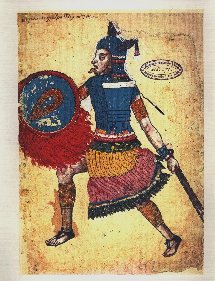
An Aztec Hymn
Nezahualcoyotl (1402-1472) was a sage and poet-king in 15th century, pre-Columbian Mexico. According to some reports, he had as many as 110 children. Curiously for the time, he apparently banned human sacrifices in his jewel-encrusted temples and ziggurats, and only allowed offerings of flowers and incense. (This, of course may have been a romanticisation, designed to make his memory more honourable in the eyes of the Christian conquistadors who arrived soon after his death.)
This is my translation of a prayer/poem he wrote, committed to paper (and Spanish) by his grandson, Juan Bautista de Pomar.WE ONLY LIVE IN YOUR BOOK OF PAINTINGS
With flowers you paint,
O Giver of Life!
With songs you give us colour,
With songs you shade
Those who will live on the earth.
Later,
You will destroy the eagles and the tigers:
We live only in Your painting
Here, on the earth.
With black ink
You will blot out
All that was -
Friendship,
Brotherhood,
Nobility.
You give shading
To those who will live on the earth.
We live only in Your book of paintings,
Here, on the earth
Friday, May 9, 2008
A Song of Love
מַיִם רַבִּים, לֹא יוּכְלוּ לְכַבּוֹת אֶת-הָאַהֲבָה, וּנְהָרוֹת, לֹא יִשְׁטְפוּהָ; אִם-יִתֵּן אִישׁ אֶת-כָּל-הוֹן בֵּיתוֹ, בָּאַהֲבָה--בּוֹז, יָבוּזוּ לוֹ.
This is from the Song of Songs (8:6,7).
It's one of my favourite songs in the world - it was set to music by Bezalel Aloni and recorded by Ofra Haza on her album Shaday.
Here's my version of the lyrics, in English.
Set me as a seal on your heart,
as a seal on your arm;
since love is as strong as death,
jealousy is cruel as the grave;
its flashes are flashes of fire,
a raging flame.
Raging waters could not quench my love,
nor could the floods drown it;
if one offered for love
all the wealth of one's house,
one would be utterly condemned.
Thursday, May 8, 2008
Fonts.
Thoughts on Translation (I)
I found the piece in a blog called Brave New Words. Which is very much worth a look!
'Tis true composing is the nobler part,
But good translation is no easy art:
For tho' materials have long since been found,
Yet both your fancy and your hands are bound;
And by improving what was writ before,
Invention labours less, but judgment more.
Each poet with a different talent writes,
One praises, one instructs, another bites.
Horace did ne'er aspire to epic bays
Nor lofty Maro stoop to lyric lays.
Examine how your humour is inclin'd,
And watch the ruling passion of your mind.
Then seek a poet, who your way does bend.
And chuse an author, as you chuse a friend.
United by this sympathetic bond,
You grow familiar, intimate, and fond;
Your thoughts, your words, your stiles, your souls agree,
No longer his interpreter, but he.
Thus far...
So, here - in no particular order - are the texts I have been working on. If it's in dark red, I'm still working on it. If it's in dark blue, it's been performed.
And any day now some of them will be published!
PLAYS:
Euripides: Medea
Euripides: Trojan Women (Two versions)
Euripides: Orestes
Euripides: The Bacchae
Aristophanes: Lysistrata
Sophocloes: The Women of Trachis
Yukio Mishima: Modern Noh Plays
(Yoroboshi, Sotoba Komachi, Dojoji, Kantan, Hanjo, The Damask Drum, The Lady Aoi, Yuya)
Iakovos Kampanellis: O Deipnos (Supper)
(Letter To Orestes, Supper, Sideroads to Thebes)
Fernando Arrabal: ...and they put handcuffs on the flowers...
Robert Thomas: Eight Women
Pierre Marivaux: The Double Inconstancy
Federico Garcia Lorca: Doña Rosita the Spinster (or, The Language of Flowers)
Mariano Pensotti: La Marea (Interior Spaces)
POETRY:
Various pieces by
Federico Garcia Lorca,
Catullus,
Jean-Jacques Goldman,
Propertius,
Juvenal,
Pablo Neruda,
Octavio Paz,
Ovid
and a variety of obscure Japanese poets.