Tuesday, May 13, 2008

An Aztec Hymn


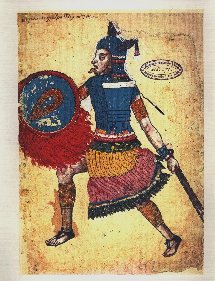
Nezahualcoyotl (1402-1472) was a sage and poet-king in 15th century, pre-Columbian Mexico. According to some reports, he had as many as 110 children. Curiously for the time, he apparently banned human sacrifices in his jewel-encrusted temples and ziggurats, and only allowed offerings of flowers and incense. (This, of course may have been a romanticisation, designed to make his memory more honourable in the eyes of the Christian conquistadors who arrived soon after his death.)

This is my translation of a prayer/poem he wrote, committed to paper (and Spanish) by his grandson, Juan Bautista de Pomar.

WE ONLY LIVE IN YOUR BOOK OF PAINTINGS

With flowers you paint,
O Giver of Life!
With songs you give us colour,
With songs you shade
Those who will live on the earth.

Later,
You will destroy the eagles and the tigers:
We live only in Your painting
Here, on the earth.

With black ink
You will blot out
All that was -
Friendship,
Brotherhood,
Nobility.

You give shading
To those who will live on the earth.
We live only in Your book of paintings,
Here, on the earth

Friday, May 9, 2008

A Song of Love

שִׂימֵנִי כַחוֹתָם עַל-לִבֶּךָ, כַּחוֹתָם עַל-זְרוֹעֶךָ--כִּי-עַזָּה כַמָּוֶת אַהֲבָה, קָשָׁה כִשְׁאוֹל קִנְאָה: רְשָׁפֶיהָ--רִשְׁפֵּי, אֵשׁ שַׁלְהֶבֶתְיָה.
מַיִם רַבִּים, לֹא יוּכְלוּ לְכַבּוֹת אֶת-הָאַהֲבָה, וּנְהָרוֹת, לֹא יִשְׁטְפוּהָ; אִם-יִתֵּן אִישׁ אֶת-כָּל-הוֹן בֵּיתוֹ, בָּאַהֲבָה--בּוֹז, יָבוּזוּ לוֹ.

This is from the Song of Songs (8:6,7).
It's one of my favourite songs in the world - it was set to music by Bezalel Aloni and recorded by Ofra Haza on her album Shaday.

Here's my version of the lyrics, in English.

Set me as a seal on your heart,
as a seal on your arm;
since love is as strong as death,
jealousy is cruel as the grave;
its flashes are flashes of fire,
a raging flame.

Raging waters could not quench my love,
nor could the floods drown it;
if one offered for love
all the wealth of one's house,
one would be utterly condemned.

Thursday, May 8, 2008

Fonts.


The font layout of the last post(s) is annoying me.

How ironic! The hardest language to use on the internet is HTML.

(*Update: 2am - it's also the most reliable. If it's not working, it's because there's a kink. Remove the kink and you remove the problem. My blog is pretty again. I'm going to sleep.)

Thoughts on Translation (I)

I found this rather charming extract from "An Essay on Verse Translation" by Wentworth Dillon, Fourth Earl of Roscommon (1630-85). He's describing what should theoretically draw a potential translator to work on a particular artist's work.

I found the piece in a blog called Brave New Words. Which is very much worth a look!

'Tis true composing is the nobler part,
But good translation is no easy art:
For tho' materials have long since been found,
Yet both your fancy and your hands are bound;
And by improving what was writ before,
Invention labours less, but judgment more.

Each poet with a different talent writes,
One praises, one instructs, another bites.
Horace did ne'er aspire to epic bays
Nor lofty Maro stoop to lyric lays.
Examine how your humour is inclin'd,
And watch the ruling passion of your mind.
Then seek a poet, who your way does bend.
And chuse an author, as you chuse a friend.
United by this sympathetic bond,
You grow familiar, intimate, and fond;
Your thoughts, your words, your stiles, your souls agree,
No longer his interpreter, but he.

Thus far...

I suppose it's only appropriate here to list, by way of introduction, the kinds of things I translate.

So, here - in no particular order - are the texts I have been working on. If it's in dark red, I'm still working on it. If it's in dark blue, it's been performed.

And any day now some of them will be published!

PLAYS:

Euripides: Medea
Euripides: Trojan Women (Two versions)
Euripides: Orestes
Euripides: The Bacchae
Aristophanes: Lysistrata
Sophocloes: The Women of Trachis

Yukio Mishima: Modern Noh Plays
(Yoroboshi, Sotoba Komachi, Dojoji, Kantan, Hanjo, The Damask Drum, The Lady Aoi, Yuya)

Iakovos Kampanellis: O Deipnos (Supper)
(Letter To Orestes, Supper, Sideroads to Thebes)

Fernando Arrabal: ...and they put handcuffs on the flowers...
Robert Thomas: Eight Women
Pierre Marivaux: The Double Inconstancy

Federico Garcia Lorca: Doña Rosita the Spinster (or, The Language of Flowers)

Mariano Pensotti: La Marea (Interior Spaces)


POETRY:

Various pieces by

Federico Garcia Lorca,
Catullus,
Jean-Jacques Goldman,
Propertius,
Juvenal,
Pablo Neruda,
Octavio Paz,
Ovid
and a variety of obscure Japanese poets.


It's not just the words...


I found this wonderful sketch while surfing the net tonight looking for images of calligraphy.
It's a beautiful example of zoomorphic calligraphy - and a curious melange of metaphors.

It reminds me of Neil Bartlett, commenting on his own translation of Racine's Bérénice; he said that encountering this play was like seeing a wild tiger in its cage - the tiger was the ferocity and passion of the story, while the bars of the cage were represented by Racine's beautiful but strict adherence to his alexandrines.

Here that analogy is made visual - the tiger is constructed from the brushstrokes of Arabic script.

All that, or else it's just a cool doodle ;)

A beginning.


I've been working a lot on translations, for a number of years. And I have never really engaged with the process of it very much - usually because I have a deadline and a piece of work to complete!!

As I face into this summer of 2008 and a period in which I'm planning to complete a number of projects that have been put on my long fingers for a long time, I'm starting the blog to document my translating work.

I hope you'll come on these journeys with me.

[A note on the blog's title: Mnemosyne was the Greek goddess of Memory, and was also the goddess of the Muses. She is also credited with the invention of words. These strange mythological connections between language, inspiration, creativity, past, present and future are remarkably prescient. Babel was, of course, the Biblical site of the confusion of languages, in the Book of Genesis.]